Let’s be real: having hard conversations isn’t anybody’s favorite pastime. But in this life, avoiding them only makes things worse.
I’ve been in situations where I felt completely unheard. I’ve stayed in uncomfortable dynamics where I appeased the other person just to survive the moment or keep the peace. But doing that doesn’t help anyone. You end up invalidating your own feelings, suppressing your truth, and slowly building a deep wall of resentment.
I was talking to my man the other day and I love the way he talks about “silent resentment.” It’s made of all the small moments you choose not to address. Because when you stay silent, those unsaid words accumulate inside you until the weight becomes unbearable. That break down was so easy for me to understand and be able to recognize if I ever find myself in that pattern.
If you’ve ever hesitated to speak up because you were scared the conversation might permanently alter a dynamic with a person, you’re not alone. I’ve been there too. I have a solution for you:
Here is the 3-step framework I used over the past year to navigate hard conversations while keeping my composure and respecting my boundaries:
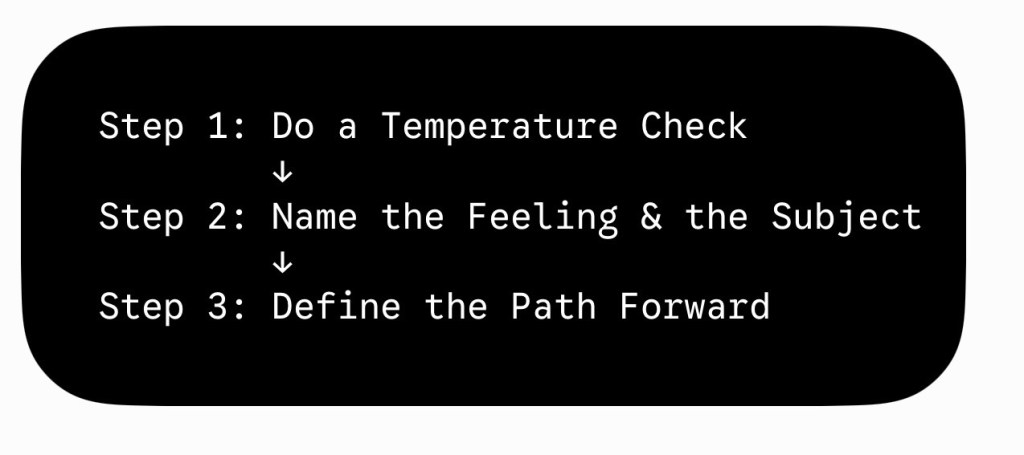
1. Temperature Check
Before jumping into the heavy stuff, become an observer. Read the room and read your body. You can feel tension in the air if you’re paying attention, just like you can feel your own body tightening up. Gauging the environment allows you to approach the moment intentionally instead of reactively.
2. Name What You’re Feeling (and Name the Subject)
Be transparent upfront. It’s okay to say: “This conversation is really hard for me. I might need to pause for a second because I feel uncomfortable, but I respect you enough to have this talk.” Lay out the topic clearly without dancing around it.
3. Figure Out the Way Forward
The reason hard conversations feel so intimidating is that most people don’t know how to end them. Ending a tough talk requires determining what happens next:
Is the other person open to changing or moving forward?
Or are they going to hold onto resentment and repeat the same behaviors?
I used to expect everyone to handle tough conversations the way I do. But people process things through their own capacity. Having this 3-step system helps me stay level, calm, and honest with myself.
I don’t have to like everyone, and everyone isn’t going to like me. But if a conversation happens and changed behavior doesn’t follow, I can set my boundaries with peace, knowing I tried.
As the saying goes: There’s a pot for every lid, but there are only four burners on the stove. You get to decide who and what gets space on your stovetop.
I’d love to hear from you: Are hard conversations easy for you to initiate, or do you tend to avoid them until silent resentment builds up? Let’s talk about it in the comments below!
From my writing corner with love,
Teish

